
Vapor Intrusion Source Identification: When the Obvious Source Isn’t the Real One

When the Obvious Source Isn’t the Real One: Vapor Intrusion
Vapor intrusion cases carry a particular kind of pressure. A building shows detectable levels of benzene, toluene, or other volatile compounds in its indoor air, there is a known contamination source somewhere nearby or below, and everyone in the room wants an answer to the same question: is the vapor from that source actually getting into the building, or is something else going on? The stakes are immediate, because a confirmed vapor intrusion pathway usually means costly mitigation, while a false alarm can send a property owner or responsible party down an expensive and unnecessary path. Our team has spent a good deal of time working through cases exactly like this (1), where the presence of contaminants indoors was never really in question, but the source of those contaminants was a head-scratcher.
Why Standard Vapor Intrusion Testing Can’t Identify the Source
The typical starting point for a vapor intrusion investigation is a standard laboratory method that screens indoor air for a defined list of volatile organic compounds representing a wide range of sources from decades ago. That method works well for identifying the presence of a health-relevant chemical, and it is usually enough to close out a case when the answer is clear. But standard testing includes only a small handful of compounds from a wide range of sources, which limits its usefulness when the site in question involves gasoline, diesel, or coal tar comprised of dozens of compounds. Petroleum and tar products contain hundreds of individual hydrocarbons, and a screening list built around a dozen or so of them often cannot distinguish one hydrocarbon source from another, particularly when concentrations are low and hover in the range typical of ordinary background air. In cases like these, the standard result can signal a problem without identifying the source.

Hydrocarbon Fingerprinting for Vapor Intrusion Investigations
To fill that gap, our team developed guidance for the Navy utilizing a more expansive laboratory approach that measures a much wider range of hydrocarbon compounds in air, soil gas, and groundwater, including compound families that barely register in standard testing (2). Looking at the fuller mixture, rather than a narrow slice of it, brings out patterns that are specific to how a particular hydrocarbon product was formed or refined. Gasoline, diesel, kerosene, and coal tar each tend to leave behind a distinctive proportion of these compound families, and comparing that proportion across samples collected indoors, outdoors, and in the soil beneath a building offers a way to trace whether the vapors detected inside a structure resemble the vapors coming from a suspected source, or whether they look like something else entirely.

Case Study 1: BTEX in Indoor Air Near a Petroleum Plume
In one case, a routine environmental review ahead of a real estate transaction turned up low levels of BTEX compounds in the indoor air of a commercial building. Investigators already identified a plume of petroleum product floating on groundwater a short distance away, and the obvious assumption was that vapors from that plume migrated into the building. Our team set out to test that assumption directly by characterizing the chemical makeup of the petroleum product itself, estimating what its vapor phase would look like once it reached the subsurface, and comparing that estimate against what was actually measured in the building’s indoor air and in the air just outside it.
The comparison told a different story than expected. The chemical composition of the indoor air did not resemble the vapor signature predicted from the nearby petroleum product. Instead, the indoor air closely resembled the ambient air measured just outside the building. That similarity, evaluated at both a broad and a detailed chemical level, pointed toward common outdoor influences, such as everyday vehicle traffic, rather than the underground plume, as the more plausible explanation for what was showing up indoors. Uncombusted fuel escapes the vehicle under three primary scenarios: (1) when the air-fuel mixture is too rich (the amount of fuel is greater than the available oxygen) during cold starts, deceleration, and running a poorly maintained engine; (2) fuel migrates into “crevice volumes” beyond the reach of the cylinder stroke flame; and (3) evaporation from the fuel tank, lines, or carburetor. As a result, combustion byproducts and vapor phase gasoline/diesel can be detected near most roadways and intersections.
Case Study 2: A Former Manufactured Gas Plant and Gas Station
A second case involved a broader stretch of a residential and commercial neighborhood situated downgradient from a former manufactured gas plant and an old automobile service station. Both sites had documented historical releases decades earlier. Indoor air testing across the neighborhood turned up low concentrations of BTEX compounds, raising the question of whether vapors from either legacy source migrated upward into homes and businesses.
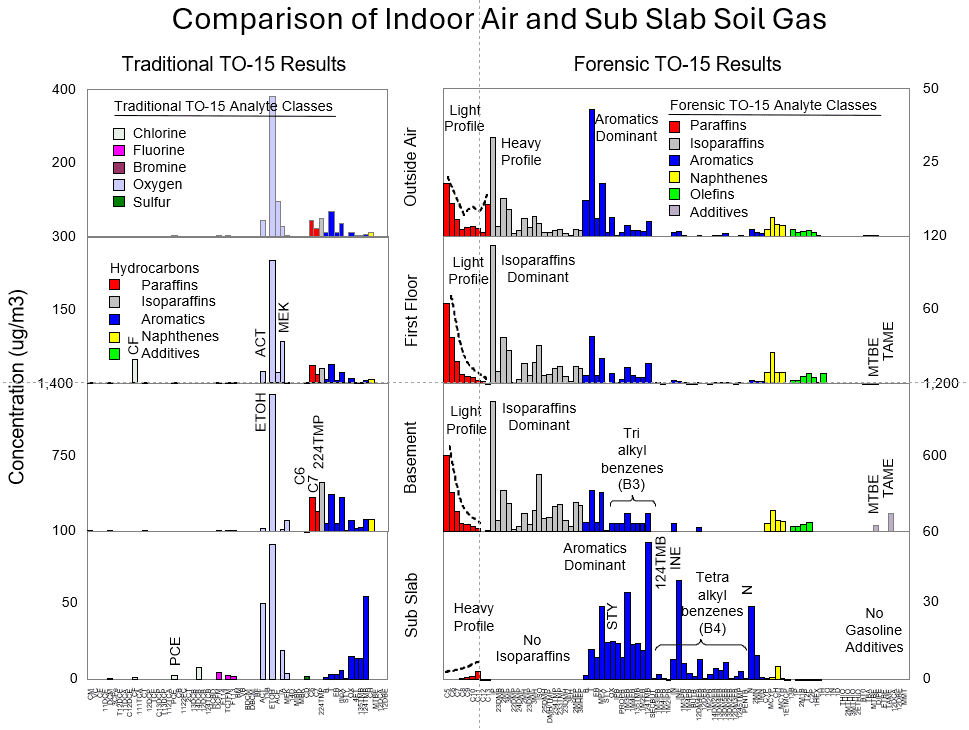
Our team characterized the chemical fingerprints of the known source materials, gasoline, diesel fuel, and coal tar, and compared them against soil gas collected beneath several buildings, indoor air, and background outdoor air gathered over an extended period. The source materials turned out to have distinctive and separable chemical signatures from one another. But the composition of the soil gas beneath the building nearest the old industrial sources did not match what was found indoors, and the concentrations in the soil gas were far lower than what would be expected if that soil gas were actually migrating upward and mixing into the building’s air. The indoor air instead reflected a mixture more consistent with everyday sources: some residual influence from ambient outdoor air, along with hydrocarbon patterns associated with vehicular traffic unrelated to the decades-old releases nearby. Across the wider study area, other buildings showed broadly similar patterns, with most of the variation tied to routine household products and activities rather than to historical industrial sources.
What This Means for Vapor Intrusion Claims and Litigation
Cases like these highlight a distinction that matters well beyond environmental chemistry: the presence of a contaminant and the identity of its source are two separate questions. Answering the first does not automatically answer the second. A nearby plume or a documented historical release can look, on paper, like the obvious explanation for what shows up in indoor air testing, and a screening-level result can be enough to raise real concern. But a fuller chemical comparison sometimes tells a different story, one where the suspected source and the observed contamination simply do not match, and where everyday background influences turn out to explain what initially looked alarming. For legal and risk professionals evaluating exposure claims, remediation obligations, or the strength of a causation argument, that distinction can shape the direction of a matter substantially. Chemical fingerprinting can offer an independent, evidence-based examination of candidate sources, migration pathways, and actual indoor air impacts.
- Plantz, G. McCarthy, K.J., Emsbo-Mattingly, S.D., Uhler, A.D., and Stout, S.A. (2008) “Evaluating the Vapor Intrusion Pathway – Challenges and Source Identification.” Environ. Claims J., 20(1): 71-86.
- Emsbo-Mattingly, S.D. and Uhler, A.D. (2011) Environmental Forensic Methods for Vapor Intrusion. In: NAVFAC Guidance for Environmental Background Analysis Vol. IV: Vapor Intrusion Pathway User’s Guide UG-2091-ENV, Washington D.C.20374-5065. pp. 55-76.
Need Source Identification Expertise?
From source identification to litigation support, our team is here to help you move forward with confidence. Contact our specialists today.
Schedule a Consultation