
Differentiating Commingled PCE and TCE Plumes
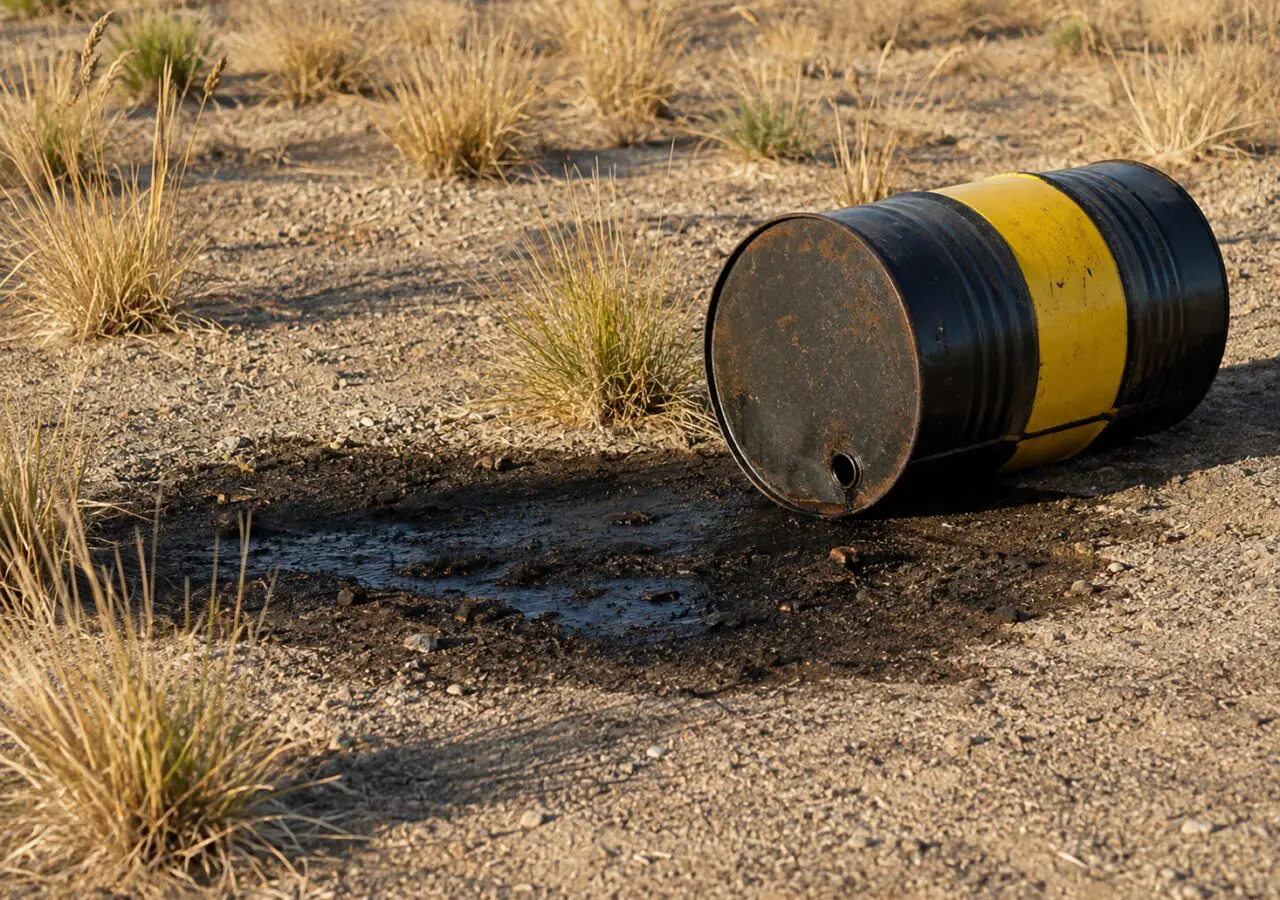
Groundwater contamination is prevalent in the developed world due to incidental industrial, commercial, and residential releases of solvents, cleaners, refrigerants, and other substances. The diversity of sources can present complicated source-identification challenges in areas with multiple potential origins. Environmental investigations in developed areas often encounter sites where several historical operations each had plausible access to chlorinated solvents, and where the resulting contamination may have mixed, migrated, and degraded underground for decades before anyone thought to sample it. Chemistry alone, in the form of concentration maps and conventional assessment techniques, may not answer the question that matters most in environmental liability disputes: whose release actually reached the area of concern?
Case Study
A recent case handled by our environmental forensics team shows how an integrated technical approach resolved exactly that question at a site with three candidate sources, a groundwater-altering tidal creek, and years of ambiguous monitoring data.
Setting
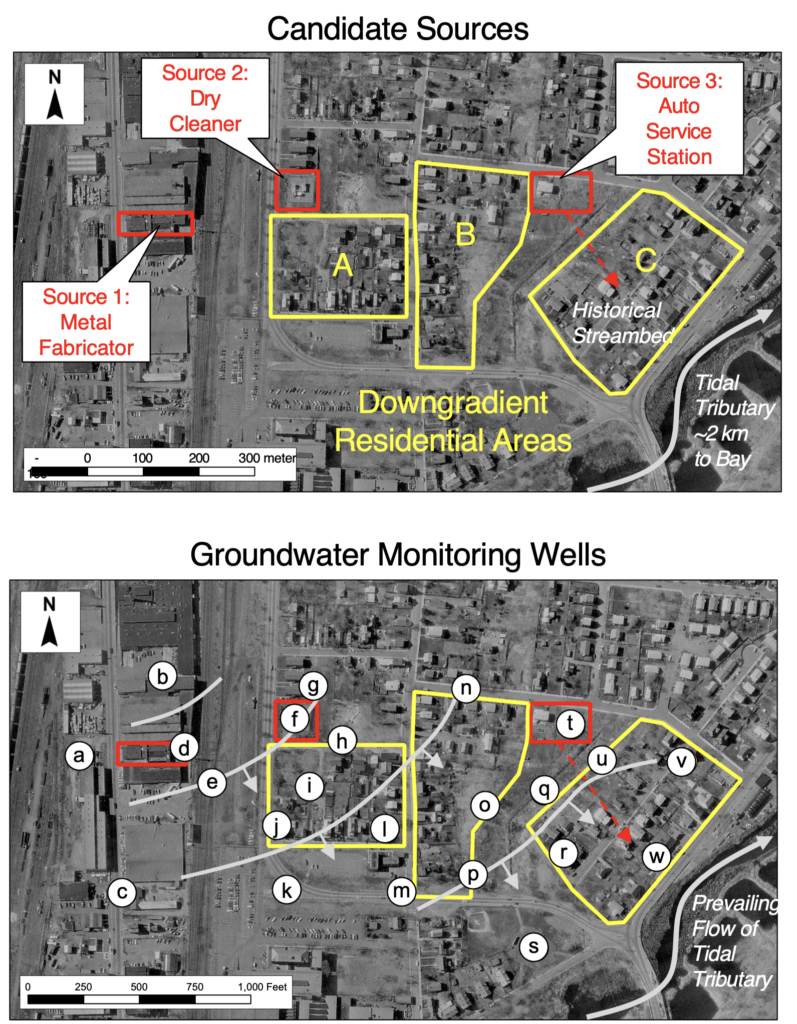
The site sat along a tidal tributary and hosted three historical operations with documented or suspected use of chlorinated solvents: a metal fabricator, a dry cleaner, and an automotive service station.
Regulatory sampling over the years identified tetrachloroethylene (PCE), trichloroethylene (TCE), and their breakdown products in groundwater within several down gradient residential areas near each candidate source. Some investigators concluded that the party with the “deepest pockets” caused all groundwater impacts, while others argued for multiple-source models. Concentration patterns alone did not satisfactorily resolve the dispute.
Seasonal and tidal influences shifted the piezometric surface. Groundwater sometimes flowed southeast, sometimes more southerly, sometimes more easterly. That instability raised important legal and technical questions: did contamination from the metal fabricator or the dry cleaner actually migrate far enough, and in the right direction, to reach the third downgradient area nearest the tributary? Put simply, how many sources actually impacted groundwater in each residential area, and should the cost of remediation be allocated among multiple parties more accurately?
These are typical questions that drive cost-allocation disputes, third-party claims, and settlement negotiations. Incorrect forensic interpretations produce real financial consequences.
Why Concentration Data Alone Wasn’t Enough
Conventional environmental data, meaning the measurement of regulated compound concentrations (e.g., PCE, TCE, and their degradation products) at each monitoring well, is essential for establishing risk and regulatory compliance. But that same data can be limited for source attribution. Concentrations decline with distance from a source for many reasons, including simple dilution, and they can look similar in downgradient areas affected by multiple, unrelated releases. In a commingled-plume scenario, a concentration map can suggest one continuous, connected plume when the underlying reality is two or three separate plumes that happen to flow near each other.
Building the Case Through Multiple, Independent Lines of Evidence
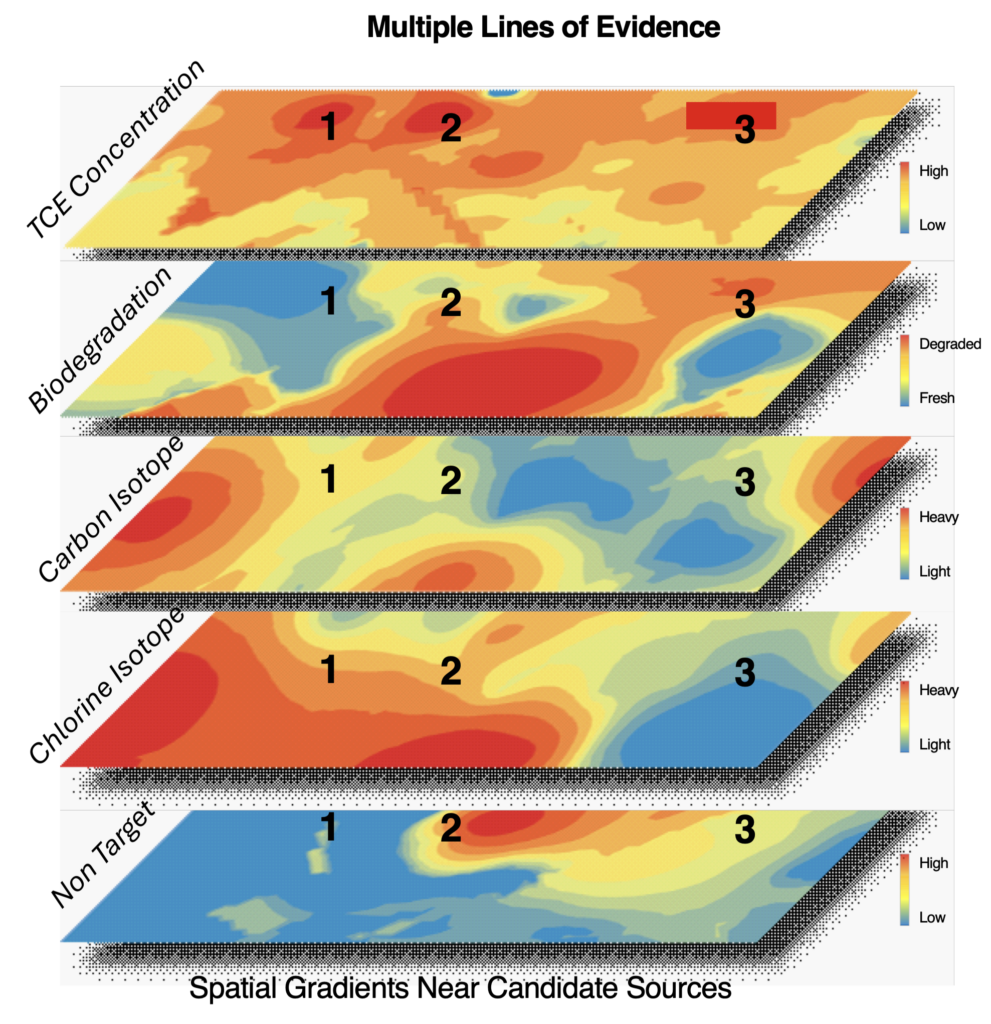
To move past that ambiguity, the investigation supplemented the standard chlorinated-solvent concentration data with several independent lines of evidence, each capable of telling a different part of the story.
Non-Target Analysis
Beyond the regulated compounds themselves, the laboratory data were re-evaluated for non-target analytics (i.e., unregulated petroleum hydrocarbons, oils, and dry-cleaning-specific solvents) that were co-released alongside the PCE and TCE. For example, dense non-aqueous phase liquid (DNAPL) recovered near the dry cleaner carried a hydrocarbon signature (a decades-old dry-cleaning fluid called Stoddard solvent, along with mineral oils) that was distinct from the diesel and lubricating-oil signature found near the service station. These chemical fingerprints work like a signature on a legal document: they tie a specific contamination pattern to a specific type of historical operation.
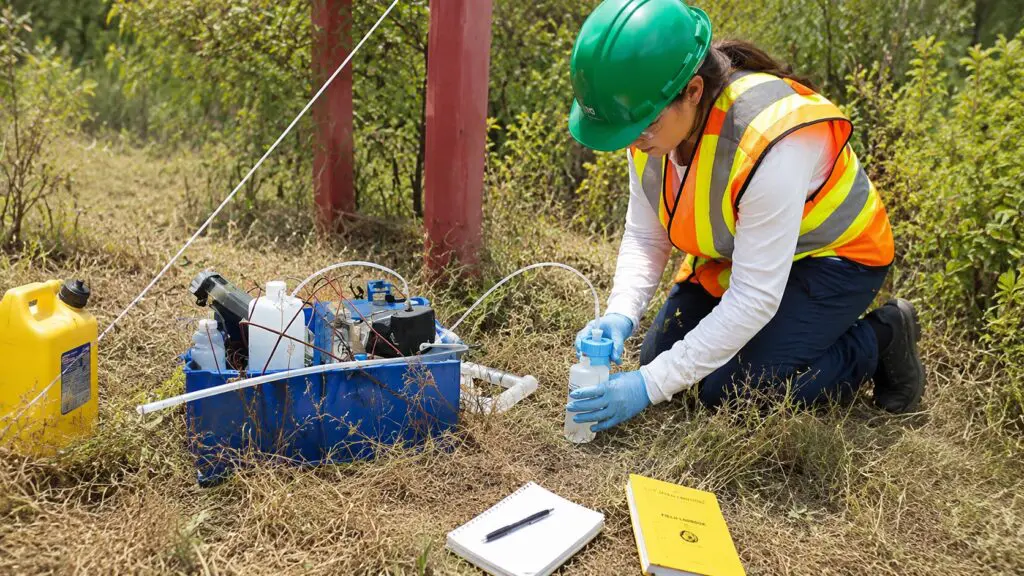
Biodegradation Indices
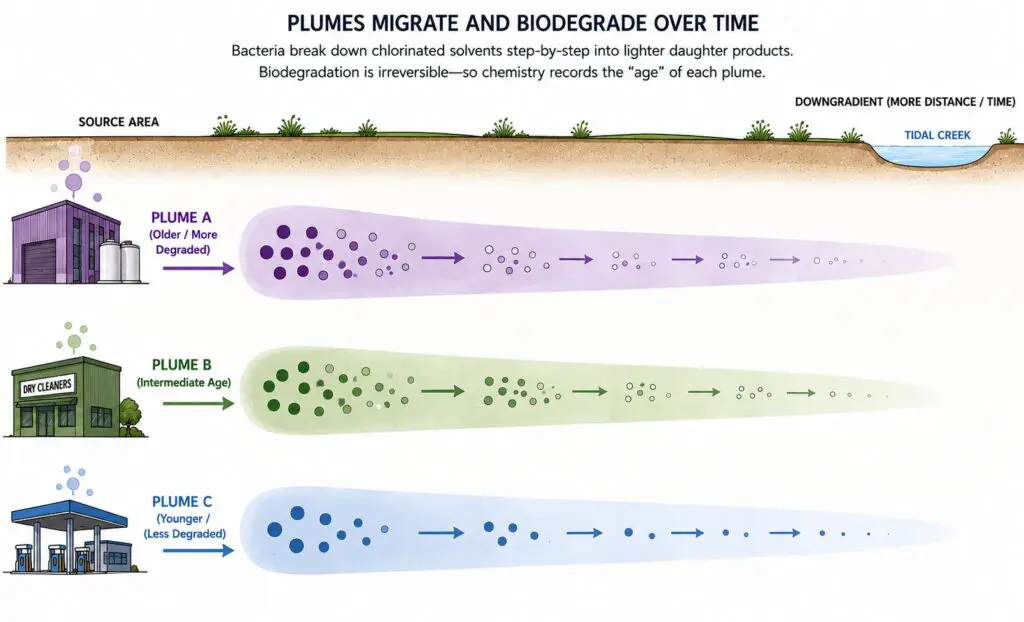
Chlorinated solvents don’t sit in groundwater unchanged. Soil bacteria break down PCE and TCE, step by step, into isotopically lighter daughter products and isotopically heavier parent residues. Because this breakdown is irreversible, the ratio of the daughter byproduct to parent compound at any given well works like an odometer reading: it shows the degree of biodegradation (i.e., aging) at each groundwater monitoring location.
Comparing biodegradation indices across the site revealed that groundwater associated with Residential Areas A and B were substantially more degraded (older) than the fresher-looking contamination near Residential Area C. That mismatch strongly suggested the fresher signal near the tributary had an independent, more localized origin (Source 3), rather than being the tail end of a plume that traveled from the more distant sources (Sources 1 and 2).
Carbon and Chlorine Isotopes
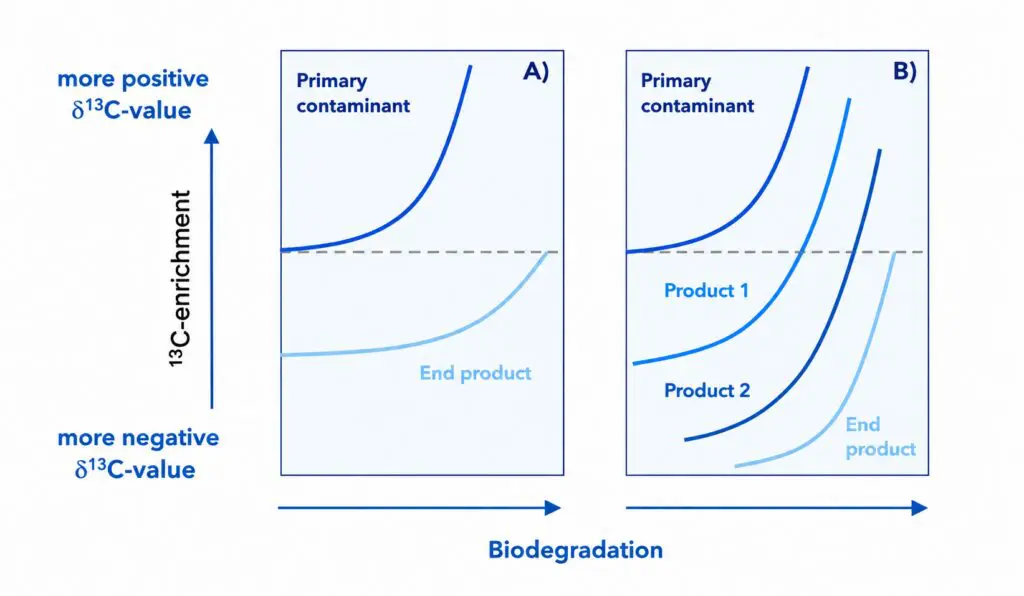
A more distinctive forensic approach can include compound-specific isotope analysis (CSIA): the measurement of isotopic differences in the carbon and chlorine within the solvent molecules themselves. Isotope ratios are set, in part, at the time of manufacture, and then shift in a predictable, one-directional process that tracks the irreversible biodegradation of each plume.
The isotope ratios help track each individual plume from its source area to its down gradient boundary. The technique helps confirm the prevailing groundwater flow direction and helps demonstrate commingling: one TCE plume associated with the metal fabricator and dry cleaner, while the second (isotopically lighter) signature tracked the service station plume. Plotted spatially, the isotope values showed a logical progression of two independent plumes that biologically “age” as they migrate away from their sources. Forensically, the isotope chemistry ruled out a hydraulic connection between those two sources within the residential area nearest the tributary: a distinction the raw concentration maps alone could not make.
The Resolution
Taken together, the multiple lines of evidence converged on a clear conclusion. Contamination in two of the three down gradient areas (A&B) was consistent with historical releases from the metal fabricator (1) and the dry cleaner (2), while the area nearest the tributary (C) was attributable to a separate release associated with the service station (3), not the other two sources. The isotope and biodegradation evidence also revealed a low-level regional background of TCE unrelated to any of the three candidate sources, a detail that kept the final allocation analysis from being skewed by background conditions.
Why Environmental Forensics Matters
Contaminated sites with multiple potential sources and commingled plumes are common in urban and industrial areas. When concentration contour maps alone fail to resolve complex liability questions, a robust forensic toolbox is available. Existing data can be used to construct biodegradation indices. Where more resolution is needed, forensic confirmation samples can be collected and analyzed for non-target compounds and CSIA methods for sharper plume delineation.
Collectively, multiple lines of evidence can directly reveal whether a given source contributed to specific groundwater impacts, rather than leaving that question to inference and argument. The same evidence supports cost allocation for past investigations and informs future contribution agreements. Complex chlorinated-solvent sites sometimes require site-specific, multiple-lines-of-evidence approaches capable of turning genuinely ambiguous fact patterns into defensible, data-supported conclusions.
Citation:
Stephen David Emsbo-Mattingly, Katherine Leigh Flanders & Eric Robert Litman (2023) “Integrated differentiation of multiple trichloroethylene and tetrachloroethylene groundwater impacts using spatial concentration, biodegradation indices, chemical fingerprinting and carbon/chlorine isotope patterns.” Environmental Forensics, 24 (5-6): 329-350. DOI: 10.1080/15275922.2022.2047832
Need Source Identification Expertise?
From source identification to litigation support, our team is here to help you move forward with confidence. Contact our specialists today.
Schedule a Consultation